When Coral Speaks in Parliament: India’s Coral Bleaching Crisis
- Samudra Conservation

- Aug 15, 2025
- 4 min read
By Sarah Drego & Prajakta Kuwalekar, Samudra Conservation

The ocean sent India a distress call - and this time, it was loud enough to echo through the halls of Parliament.
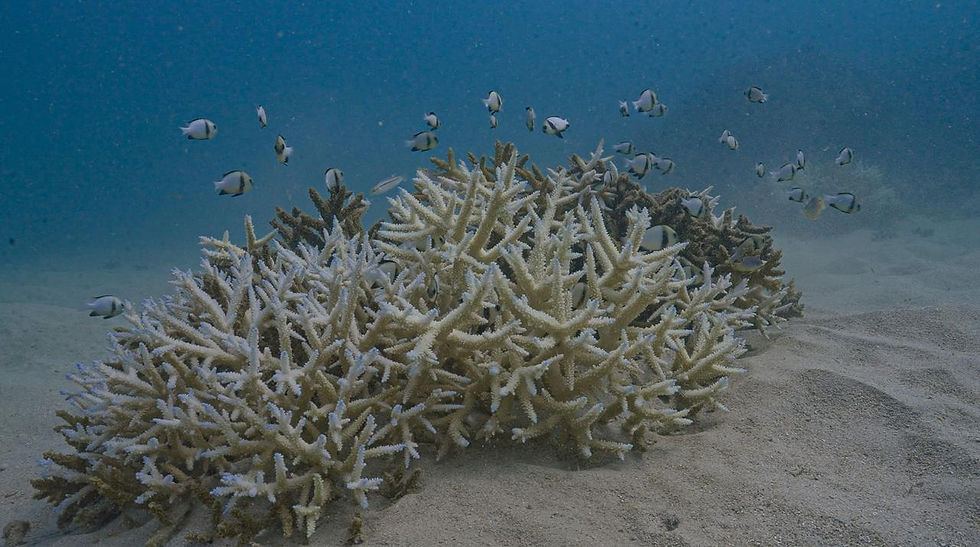
In 2024, our oceans experienced what scientists have coined as The 4th Global Coral Bleaching Event (GCBE4). With 70.7% of corals affected worldwide and a staggering 84.6% of corals bleached in Lakshadweep itself, this unfolding underwater emergency caught the attention of the Lok Sabha.
This wasn’t just a minor footnote in an environmental report - but it also wasn’t the national conversation, it deserves to be. When we resurfaced from witnessing the mass bleaching, hardly anybody beyond the echo chambers of science was talking about it.
It surprised us but also supercharged us to set up Samudra.Club - a community of citizen - scientists collaborating to safeguard India’s oceans.

WHAT THE HELL HAPPENED IN INDIA
Triggered by the global El Nino phenomenon, the GCBE4 struck vital marine hotspots in India, specifically - the Andaman and Nicobar Islands, Lakshadweep Islands and Gulf of Munnar. The oceanography of these three locations creates perfect conditions for shallow coral reefs to thrive. Shallow coral reefs are where much of the life in the ocean begins their journey - a vital hotspot.
The once pristine and vibrant coral reefs of these regions turned ghostly white and silent in April - May - June 2024. The zooxanthellae residing in the coral polyps are highly temperature sensitive. When temperatures rise beyond their preferred range, they vacate the coral, leaving the coral without a food source and bleached.

Sometimes, the zooxanthellae return - coral recovers.
However, if high temperature conditions persist year-round, coral recovery is impossible. Repeated bleaching events ultimately compromise the coral's health.
“The dive site - Fish Slate in Neil Island of Andaman was one of my favourite dive sites. It was an ideal perfect coral reef with incredible fish diversity and abundant dugong and turtle sightings. After the 2024 bleaching - it is 20% of what it used to be.” ~John Anshul, Dive Tribe
REEF MONITORING INITIATIVES IN INDIA
The Indian Government has launched several programs that utilize cutting-edge technology like satellite imagery to manage and protect coral reef ecosystems. These programs are working to tackle the bleaching crisis from multiple approaches.
The National Centre Sustainable Coastal Management (NCSCM) is focused on long-term coral reef health monitoring, calcification rates and ocean acidification by deploying data buoys through their Coral Reef in situ Observation Network (CReON) program.
ISRO’s Space Applications Centre maps reefs at 1:25,000 scale, comparing satellite images from 2004–08 and 2020 to detect change and conducting reef health assessments. As a part of the Inventory of Coral Reefs project , they have mapped the reefs of Malvan, Maharashtra using Resourcesat-2 Linear Imaging Self Scanner (LISS).
INCOIS issues satellite-based bleaching alerts, which serve as an early-warning system. These alerts are triggered based on satellite derived sea surface temperatures.
National Centre for Coastal Research (NCCR), Chennai is engaged in reef health monitoring in Palk Bay, Andaman Islands and Lakshadweep.
In the Gulf of Kachchh, 16,000 corals have been relocated in what stands as the nation’s largest-ever coral translocation project, aiming to aid reef restoration. We are yet to see the results from these though.
Meanwhile, in the Gulf of Munnar and Palk Bay, restoration teams are working with nature’s toughest survivors — resilient species like Acropora, Porites, and Montipora — giving damaged reefs a second opportunity at life.
The Zoological Survey of India is also diving deep into research on bleaching resistance, coral reproduction, and ambitious large-scale transplantations, ensuring that restoration isn’t just reactive, but strategic and sustainable for the future.
ROLE OF PARLIAMENT IN REEF ADVOCACY
When an issue is brought before the Parliament, it signals that it’s no longer solely the concern of scientists and conservationists alone - it’s a national priority. A discussion of this level ensures three significant outcomes:
Acknowledgment of the urgency of the matter: Coral bleaching doesn’t affect only marine biodiversity. The repercussions are felt by coastal communities and each of us living miles away from the oceans. Climate change, storm surges, depletion of fish stocks and species extinction are all interconnected with reef health.
Mobilization of Policy and Resources: Parliamentary attention can unlock funding, direct inter-agency collaboration, and strengthen legal protections like Coastal Regulation Zone norms.
Public Awareness: Coverage in Parliament fuels media attention, public discourse, and citizen engagement.
WHERE DOES ALL THIS LEAD?
India needs a framework and a plan to bring different policy as well as science stakeholders together and a forward thinking time-bound plan to address coral reef management and restoration.
India also needs standards and an open access open data platform where all of the stakeholders can collaborate, share knowledge and innovate in agile ways.
India also needs significant investment in bringing in technology to accelerate reef management. AI, acoustic sensors, drones, and telemetric data can also be used alongside India’s digital public infrastructure for this purpose.
We are at a critical juncture. We have a very short duration of time to attempt to make coral reefs of India more resilient to climate change.
The Parliament is finally listening to the reefs. It’s now our job to make sure those voices turn into tangible action - on the shores, in policy halls, and in our everyday choices.
The ocean has spoken. How will we respond?

Join our Samudra Community and subscribe to our monthly newsletter to stay up to date on ocean science and policy news from the Global South
Instagram: @samudra.club
Contact us: samudraconservation@gmail.com


Comments